

Which Of The Following Is Not A Functions Of Money
Affiliate 27. Money and Banking
27.1 Defining Coin by Its Functions
Learning Objectives
Past the cease of this department, you will be able to:
- Explain the various functions of money
- Contrast commodity coin and fiat coin
Money for the sake of money is not an end in itself. You cannot eat dollar bills or vesture your bank account. Ultimately, the usefulness of money rests in exchanging information technology for goods or services. Every bit the American writer and humorist Ambrose Bierce (1842–1914) wrote in 1911, money is a "blessing that is of no advantage to united states excepting when we part with information technology." Coin is what people regularly use when purchasing or selling goods and services, and thus money must exist widely accepted by both buyers and sellers. This concept of money is intentionally flexible, because money has taken a wide diversity of forms in different cultures.
Barter and the Double Coincidence of Wants
To sympathise the usefulness of money, we must consider what the world would be like without money. How would people commutation appurtenances and services? Economies without money typically engage in the barter system. Barter—literally trading one skillful or service for another—is highly inefficient for trying to coordinate the trades in a modern advanced economy. In an economy without money, an commutation betwixt two people would involve a double coincidence of wants, a state of affairs in which two people each want some good or service that the other person can provide. For example, if an accountant wants a pair of shoes, this auditor must find someone who has a pair of shoes in the right size and who is willing to exchange the shoes for some hours of accounting services. Such a trade is probable to be difficult to conform. Think nearly the complication of such trades in a modern economy, with its all-encompassing division of labor that involves thousands upon thousands of different jobs and goods.
Another problem with the barter system is that it does non allow united states to hands enter into hereafter contracts for the purchase of many goods and services. For example, if the goods are perishable it may exist hard to exchange them for other goods in the future. Imagine a farmer wanting to buy a tractor in half-dozen months using a fresh crop of strawberries. Additionally, while the barter system might piece of work adequately in small economies, information technology volition keep these economies from growing. The time that individuals would otherwise spend producing appurtenances and services and enjoying leisure time is spent bartering.
Functions for Money
Money solves the problems created by the barter system. (Nosotros will get to its definition presently.) First, money serves equally a medium of commutation, which means that money acts as an intermediary between the buyer and the seller. Instead of exchanging accounting services for shoes, the accountant now exchanges accounting services for money. This coin is and so used to purchase shoes. To serve every bit a medium of substitution, money must exist very widely accepted equally a method of payment in the markets for goods, labor, and financial capital.
Second, money must serve equally a store of value. In a barter arrangement, we saw the example of the shoemaker trading shoes for bookkeeping services. Merely she risks having her shoes go out of mode, particularly if she keeps them in a warehouse for future utilize—their value will subtract with each season. Shoes are non a good store of value. Property coin is a much easier way of storing value. You know that you exercise non need to spend it immediately because it will still hold its value the adjacent day, or the next twelvemonth. This function of coin does non crave that money is a perfect store of value. In an economy with inflation, coin loses some buying power each year, but it remains money.
Third, money serves as a unit of business relationship, which means that it is the ruler past which other values are measured. For example, an accountant may charge $100 to file your tax return. That $100 can buy two pair of shoes at $l a pair. Money acts as a common denominator, an accounting method that simplifies thinking about trade-offs.
Finally, another role of money is that coin must serve every bit a standard of deferred payment. This means that if money is usable today to make purchases, it must also be acceptable to make purchases today that will be paid in the future. Loans and future agreements are stated in monetary terms and the standard of deferred payment is what allows us to purchase appurtenances and services today and pay in the futurity. So money serves all of these functions— information technology is a medium of exchange, store of value, unit of account, and standard of deferred payment.
Commodity versus Fiat Money
Money has taken a broad diverseness of forms in different cultures. Gold, silver, cowrie shells, cigarettes, and even cocoa beans take been used as money. Although these items are used equally commodity money, they also take a value from use equally something other than money. Gold, for example, has been used throughout the ages as coin although today it is not used every bit money but rather is valued for its other attributes. Gold is a good conductor of electricity and is used in the electronics and aerospace industry. Gold is also used in the manufacturing of energy efficient cogitating drinking glass for skyscrapers and is used in the medical industry besides. Of course, aureate too has value considering of its dazzler and malleability in the creation of jewelry.
As commodity money, gold has historically served its purpose as a medium of commutation, a store of value, and as a unit of account. Commodity-backed currencies are dollar bills or other currencies with values backed upwardly by gold or other commodity held at a bank. During much of its history, the money supply in the United States was backed past gold and silver. Interestingly, antique dollars dated equally tardily as 1957, accept "Silvery Certificate" printed over the portrait of George Washington, equally shown in Figure one. This meant that the holder could take the bill to the advisable banking company and exchange it for a dollar'south worth of silverish.
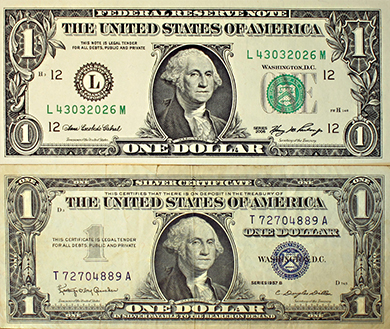
As economies grew and became more global in nature, the use of commodity monies became more than cumbersome. Countries moved towards the utilize of fiat money. Fiat money has no intrinsic value, just is declared past a government to be the legal tender of a state. The United states' paper money, for case, carries the statement: "THIS Notation IS LEGAL TENDER FOR ALL DEBTS, PUBLIC AND Individual." In other words, by regime decree, if you owe a debt, then legally speaking, yous can pay that debt with the U.Due south. currency, even though it is not backed past a commodity. The only bankroll of our money is universal faith and trust that the currency has value, and nothing more than.
Sentinel this video on the "History of Money."

Central Concepts and Summary
Coin is what people in a society regularly use when purchasing or selling goods and services. If money were not available, people would need to barter with each other, pregnant that each person would need to place others with whom they have a double coincidence of wants—that is, each party has a specific skillful or service that the other desires. Coin serves several functions: a medium of exchange, a unit of account, a shop of value, and a standard of deferred payment. There are two types of money: article money, which is an particular used as money, but which as well has value from its utilize as something other than coin; and fiat money, which has no intrinsic value, simply is alleged by a regime to be the legal tender of a land.
Self-Cheque Questions
- In many casinos, a person buys fries to utilize for gambling. Within the walls of the casino, these chips tin can often be used to buy food and drink or even a hotel room. Practice chips in a gambling casino serve all three functions of money?
- Can you lot name some particular that is a shop of value, but does non serve the other functions of money?
Review Questions
- What are the iv functions served by coin?
- How does the existence of money simplify the process of buying and selling?
- What is the double-coincidence of wants?
Critical Thinking Questions
- The Bring it Habitation Feature discusses the utilise of cowrie shells as money. Although cowrie shells are no longer used as coin, exercise you think other forms of commodity monies are possible? What office might technology play in our definition of money?
- Imagine that y'all are a barber in a world without coin. Explain why it would exist tricky to obtain groceries, clothing, and a place to live.
References
Hogendorn, January and Marion Johnson. The Beat Money of the Slave Trade. Cambridge University Press, 2003. 6.
Glossary
- barter
- literally, trading ane skilful or service for another, without using money
- commodity money
- an item that is used as coin, but which also has value from its utilise equally something other than coin
- commodity-backed currencies
- are dollar bills or other currencies with values backed up by gold or some other commodity
- double coincidence of wants
- a state of affairs in which two people each desire some proficient or service that the other person tin can provide
- fiat money
- has no intrinsic value, merely is declared by a government to exist the legal tender of a country
- medium of substitution
- whatever is widely accepted equally a method of payment
- money
- whatever serves society in four functions: every bit a medium of exchange, a store of value, a unit of account, and a standard of deferred payment.
- standard of deferred payment
- coin must too exist acceptable to make purchases today that will be paid in the future
- store of value
- something that serves every bit a way of preserving economic value that tin can be spent or consumed in the future
- unit of measurement of account
- the common mode in which market values are measured in an economy
Solutions
Answers to Self-Check Questions
- As long as you remain within the walls of the casino, fries fit the definition of money; that is, they serve as a medium of substitution, a unit of measurement of business relationship, and a store of value. Chips do not work very well as money once y'all leave the casino, simply many kinds of coin do not work well in other areas. For example, it is hard to spend money from Turkey or Brazil at your local supermarket or at the film theater.
- Many physical items that a person buys at ane time but may sell at another time can serve as an answer to this question. Examples include a house, land, art, rare coins or stamps, and and so on.
Source: https://opentextbc.ca/principlesofeconomics/chapter/27-1-defining-money-by-its-functions/
Posted by: mccullochmatived76.blogspot.com
0 Response to "Which Of The Following Is Not A Functions Of Money"
Post a Comment