

How Much Money Goes Towards Life Sentences In Prison
Life imprisonment is any sentence of imprisonment for a crime under which convicted people are to remain in prison for the rest of their natural lives or indefinitely until pardoned, paroled, or otherwise commuted to a fixed term. Crimes for which, in some countries, a person could receive this sentence include murder, torture, terrorism, child abuse resulting in death, rape, espionage, treason, drug trafficking, drug possession, human trafficking, astringent fraud and financial crimes, aggravated criminal damage, arson, kidnapping, burglary, and robbery, piracy, aircraft hijacking, and genocide, crimes against humanity, war crimes or any three felonies in instance of 3-strikes police. Life imprisonment (as a maximum term) can as well exist imposed, in sure countries, for traffic offences causing death.[1] Life imprisonment is not used in all countries; Portugal was the outset country to abolish life imprisonment, in 1885.
Where life imprisonment is a possible sentence, there may also exist formal mechanisms for requesting parole after a certain period of prison time. This means that a convict could be entitled to spend the residual of the judgement (until that individual dies) outside prison. Early on release is usually conditional on past and future comport, mayhap with certain restrictions or obligations. In dissimilarity, when a fixed term of imprisonment has ended, the captive is complimentary. The length of time served and the atmospheric condition surrounding parole vary. Beingness eligible for parole does not necessarily ensure that parole will be granted. In some countries, including Sweden, parole does non be but a life sentence may – after a successful application – be commuted to a fixed-term sentence, afterward which the offender is released as if the sentence served was that originally imposed.
In many countries effectually the world, particularly in the Commonwealth, courts have the authority to pass prison terms that may amount to de facto life imprisonment.[2] For example, courts in S Africa accept handed out at to the lowest degree two sentences that have exceeded a century, while in Tasmania, Commonwealth of australia, Martin Bryant, the perpetrator of the Port Arthur massacre in 1996, received 35 life sentences plus 1,035 years without parole, and James Holmes, perpetrator of the 2012 Aurora, Colorado shooting, received 12 sequent life sentences plus 3,318 years without the possibility of parole.[three] Whatsoever sentence without parole effectively means a sentence cannot be suspended; the prisoner may, all the same, effectively be released post-obit a pardon, either on entreatment, retrial or humanitarian grounds, such as imminent death. In several countries where "de facto" life terms are used, this is commonplace, such as in the example of Abdelbaset al-Megrahi.
A few countries permit for a pocket-size to exist given a lifetime judgement with no provision for eventual release; these include but are not limited to: Antigua and Barbuda, Argentina (simply over the historic period of 16),[4] Australia, Belize, Brunei, Cuba, Dominica, Saint Vincent and the Grenadines, the Solomon Islands, Sri Lanka, and the Us. According to a University of San Francisco School of Law written report, merely the U.S. had minors serving such sentences in 2008.[5] In 2009, Man Rights Spotter estimated that in that location were ii,589 youth offenders serving life sentences without the possibility for parole in the U.S.[6] [7] The United States leads in life sentences (both adults and minors), at a rate of l people per 100,000 (i out of 2,000) residents imprisoned for life.[8]
United States [edit]
In 2011, the Supreme Court of the U.s. ruled that sentencing minors to life without parole, automatically (as the issue of a statute) or as the result of a judicial conclusion, for crimes other than intentional homicide, violated the Eighth Subpoena's ban on "roughshod and unusual punishments", in the instance of Graham v. Florida.[9]
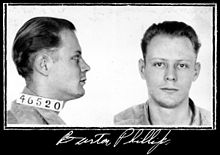
Mugshot of Burton Phillips, sentenced to life imprisonment for depository financial institution robbery, 1935
Graham v. Florida was a significant case in juvenile justice. In Jacksonville, Florida, Terrence J. Graham tried to rob a restaurant along with three boyish accomplices. During the robbery, i of Graham's accomplices had a metal bar that he used to hit the restaurant managing director twice in the caput. In one case arrested, Graham was charged with attempted armed robbery and armed burglary with assault/battery. The maximum sentence he faced from these charges was life without the possibility of parole, and the prosecutor wanted to accuse him as an adult. During the trial, Graham pleaded guilty to the charges, resulting in three years of probation, one year of which had to be served in jail. Since he had been awaiting trial in jail, he already served six months and therefore was released later half dozen additional months.[10]
Within six months of his release, Graham was involved in another robbery. Since he violated the conditions of his probation, his probation officer reported to the trial courtroom almost his probation violations a few weeks before Graham turned 18 years old. Information technology was a different judge presiding over his trial for the probation violations a year subsequently. While Graham denied any involvement of the robbery, he did admit to fleeing from the police. The trial court plant that Graham violated his probation by "committing a home invasion robbery, possessing a firearm, and associating with persons engaged in criminal action",[10] and sentenced him to 15 years for the attempted armed robbery plus life imprisonment for the armed burglary. The life judgement Graham received meant he had a life sentence without the possibility of parole, "because Florida abolished their parole system in 2003".[10]
Graham's case was presented to the U.s.a. Supreme Court, with the question of whether juveniles should receive life without the possibility of parole in not-homicide cases. The Justices eventually ruled that such a sentence violated the juvenile's 8th Amendment rights, protecting them from punishments that are disproportionate to the crime committed,[x] resulting in the abolition of life sentences without the possibility of parole in non-homicide cases for juveniles.
In 2012 the Supreme Courtroom ruled in the case of Miller v. Alabama in a 5–four decision and with the bulk stance written by Associate Justice Elena Kagan that mandatory sentences of life in prison without parole for juvenile offenders are unconstitutional. The majority opinion stated that barring a judge from considering mitigating factors and other information, such as age, maturity, and family and home surround violated the Eighth Amendment ban on cruel and unusual penalization. Sentences of life in prison without parole can still be given to juveniles for aggravated commencement-degree murder, as long every bit the approximate considers the circumstances of the case.[11] [12]
In 2016 the Supreme Courtroom ruled in the case of Montgomery five. Louisiana that the rulings imposed by Miller v. Alabama were to utilize retroactively.
Globe view [edit]
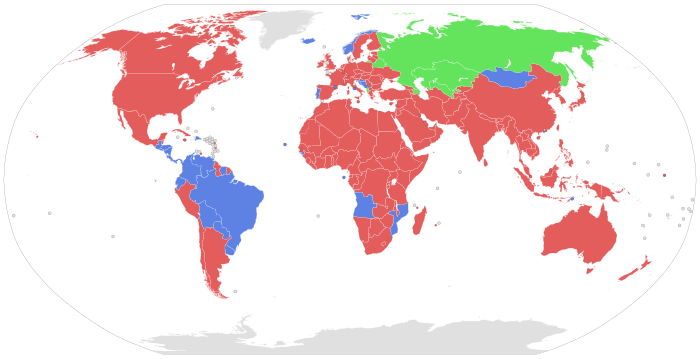
Life imprisonment laws around the globe:[13]
Life imprisonment is a legal penalty
Life imprisonment is a legal penalty, but with sure restrictions
Life imprisonment is illegal
Unknown
Reform or abolitionism [edit]
In a number of countries, life imprisonment has been effectively abolished. Many of the countries whose governments have abolished both life imprisonment and indefinite imprisonment have been culturally influenced or colonized by Spain or Portugal and have written such prohibitions into their current constitutional laws (including Portugal itself but not Espana).[14] [15]
Europe [edit]
A number of European countries have abolished all forms of indefinite imprisonment, including Republic of croatia, Bosnia and Herzegovina, which sets the maximum judgement at 45 years, and Portugal, which abolished all forms of life imprisonment with the prison reforms of Sampaio e Melo in 1884 and sets the maximum judgement at 25 years.[16] [17]
Life imprisonment in Spain was abolished in 1928, but reinstated in 2015 and upheld past the Constitutional Courtroom in 2021.[14] [fifteen] [18]
In Europe, at that place are many countries where the constabulary expressly provides for life sentences without the possibility of parole. These countries are England and Wales (within the Uk; run across Life imprisonment in England and Wales), the Netherlands, Moldova, Bulgaria,[19] Italian republic, Republic of hungary, Austria, Malta, Cyprus,[20] Albania, Ukraine, and the Republic of Ireland.
In Sweden, although the law does non expressly provide for life without the possibility of release, some convicted persons may never exist released, on the grounds that they are also unsafe. In Italy, persons that refuse to cooperate with authorities and are sentenced for mafia activities or terrorism are ineligible for parole and thus volition spend the balance of their lives in prison. In Austria, life imprisonment will mean imprisonment for the remainder of the offender'south life if clemency is rejected by the President of Austria, and in Malta, there is never any possibility of parole for any person sentenced to life imprisonment, and whatsoever grade of release from a life sentence is merely possible by clemency granted by the President of Malta.[ needs update ] In France, while the police force does not expressly provide for life imprisonment without whatever possibility of parole, a court can dominion in exceptionally serious circumstances that convicts are ineligible for parole if convicted of child murder involving rape or torture, premeditated murder of a state official or terrorism resulting in death. In Moldova, there is never a possibility of parole for anyone sentenced to life imprisonment, as life imprisonment is defined every bit "deprivation of liberty of the captive for the entire rest of his/her life". Where mercy is granted in relation to a person serving life imprisonment, imprisonment thereof must non be less than thirty years. In Ukraine, life imprisonment means for the rest of one's life with the only possibilities for release beingness a last illness or a Presidential pardon.[21] In Albania, no person sentenced to life imprisonment is eligible for parole; this effectively means imprisonment for the natural life of the convicted person, unless the prisoner is plant not likely to re-offend and has displayed adept beliefs, and the convicted person has served at least 25 years.
In the Netherlands, there is never a possibility of parole for whatsoever person sentenced to life imprisonment, and any course of release for life convicted in the country is only possible when granted royal decree past the King of the Netherlands, with the last granting of a pardon taking place in 1986 when a terminally ill captive was released. As of 1970, the Dutch monarch has pardoned a full of iii convicts. Although there is no possibility of parole eligibility, since 2016 prisoners sentenced to life imprisonment in kingdom of the netherlands are eligible to take their cases reviewed after serving at least 25 years.
Even in other European countries that practise provide for life without parole, courts continue to retain judicial discretion to decide whether a sentence of life should include parole or not. In Albania, the decision of whether or not a life convicted person is eligible for parole is upwardly to the prison house complex after 25 years has been served, and release eligibility depends on the prospect of rehabilitation and how likely he or she is to re-offend. In Europe, only kingdom of the netherlands, Ukraine, Moldova and Malta explicitly forestall parole or any grade of release for life sentences in all cases.
The Americas [edit]
In South and Central America, Republic of honduras, Nicaragua, Republic of el salvador, Republic of costa rica, Venezuela, Colombia, Uruguay, Bolivia, Ecuador, and the Dominican Democracy accept all abolished life imprisonment. The maximum sentence is 75 years in Republic of el salvador, 60 years in Republic of colombia, fifty years in Costa Rica and Panama, 40 years in Honduras, 30 years in Nicaragua, Bolivia, Uruguay, and Venezuela, and 25 years in Paraguay and Ecuador. Brazil has a maximum sentence of 40 years under the Penal Lawmaking,[22] but life imprisonment and capital punishment are provided by law for military machine crimes committed during wartime (such as treason, desertion, and mutiny) in the Constitution.[ citation needed ]
In Canada, murder carries a mandatory sentence of life imprisonment. The sentencing judge must impose a parole ineligibility catamenia of between x and 25 years in the instance of second degree murder (murder that is non start degree murder is 2d degree murder), or of 25 years in the case of get-go caste murder. In the Us, a 2009 report past the Sentencing Projection suggested that life imprisonment without parole should be abolished in the land. Some U.Due south. law enforcement officials opposed its proposed abolition.[23]
Vatican City [edit]
Pope Francis called for the abolition of both capital penalty and life imprisonment in a coming together with representatives of the International Association of Penal Police force. He also stated that life imprisonment, removed from the Vatican Urban center penal code in 2013, is simply a variation of the death penalty.[24]
Singapore [edit]
In Singapore, before 20 Baronial 1997, the law decreed that life imprisonment is a fixed judgement of twenty years with the possibility of one-third reduction of the sentence (13 years and four months) for good behaviour. It was an entreatment by Abdul Nasir bin Amer Hamsah on twenty August 1997 that led to the law in Singapore to change the definition of life imprisonment into a sentence that lasts the remainder of the prisoner's natural life, with the possibility of parole later on at to the lowest degree 20 years. Abdul Nasir was a bedevilled robber and kidnapper who was, in ii divide High Courtroom trials, sentenced to 18 years' imprisonment and 18 strokes of the cane for robbery with injure resulting in a female Japanese tourist's death at Oriental Hotel in 1994 and a consecutive judgement of life imprisonment with 12 strokes of the pikestaff for kidnapping 2 law officers for ransom in 1996, which totalled upwardly to 38 years' imprisonment and 30 strokes of the cane. His appeal for the 2 sentences to run concurrently led to the Court of Appeal of Singapore, which dismissed Abdul Nasir'due south entreatment, to decide that information technology would be wrong to consider life imprisonment every bit a stock-still jail term of twenty years and thus changed it to a jail term to be served for the rest of the prisoner'southward remaining lifespan.[25] The amended definition is applied to time to come crimes committed subsequently xx August 1997. Since Abdul Nasir committed the offense of kidnapping and was sentenced before xx August 1997, his life sentence remained equally a prison term of xx years and thus he is yet in prison house serving his 38-year jail judgement, which will maybe be reduced past 1-tertiary to 25 years and 4 months should he display practiced behaviour in jail.[26] [27] [28] [29] The appeal of Abdul Nasir, titled "Abdul Nasir bin Amer Hamsah five Public Prosecutor [1997] SGCA 38",[xxx] was since regarded as a landmark in Singapore'south legal history as information technology changed the definition of life imprisonment from "life" to "natural life" nether the law.
Notable people who were sentenced to natural life imprisonment in Singapore subsequently xx August 1997 were Muhamad Hasik bin Sahar; who killed a football game player during a viii-member Salakau gang set on and beingness convicted of manslaughter (31 May 2001), Sundarti Supriyanto who killed her employer (25 September 2004), Tony Anak Imba; who was convicted of murder for the robbery cum murder of an Indian structure worker (30 May 2010), Yong Vui Kong; a death row inmate who was initially sentenced to death for capital drug trafficking but afterwards reduced his judgement to life imprisonment following the 2013 death penalty reforms in Singapore (14 November 2013), and Kho Jabing; a death row inmate and convicted murderer who, similar Yong Vui Kong, besides managed to reduce his sentence to life imprisonment following the reform of Singapore'south death sentence laws but was once again sentenced to death merely two years later upon the prosecution's appeal against the exchange of his sentence (14 August 2013).
Despite the fact that a prisoner will be in jail for the rest of his natural life, the prison house regime will behave an annual review of the prisoner'due south conduct once the prisoner had finished serving at least 20 years of his sentence, and they volition assess the conduct through this review to see if the life convict was suitable for release on parole. If so, a remission order volition be granted with certain conditions (like never get involved in crimes once the inmate is released). If not, he will go along to be in prison for a further indefinite period until the authorities became satisfied that he is eligible for parole. 1 instance of a life convict being released on parole in Singapore was Singaporean Vincent Lee Chuan Leong, a convicted kidnapper, who, together with his two accomplices -- Zhou Jian Guang and Shi Song Jing -- from Red china, kidnapped the 14-yr-erstwhile teenage girl of a wealthy car dealer on 9 September 1999, and within the same month, all three men were soon arrested and they were sentenced to life imprisonment in April 2000, with their sentences backdated to the dates of their arrests. According to a YouTube video, Vincent Lee, who was 33 years old when committing the crime, was currently released on parole from prison at the age of 54 since 22 June 2020 later serving a total of 20 years, 10 months and 9 days in prison with good behaviour, and is employed as a lorry commuter.[31] [32] [33] [34]
Unlike the United States and certain Western countries, the electric current life imprisonment laws in Singapore did not prefer a practice of life without parole, and the courts in Singapore had never imposed whatever consecutive natural life sentences on convicts in any case since after 1997. They decreed that all those people who received fixed prison house terms other than life imprisonment would have to serve their fixed jail terms concurrently with life imprisonment, unless their life sentences were reduced and thus made the fixed jail terms to run consecutively with the reduced sentence.[35]
Other than that, life imprisonment is the adjacent highest punishment which Singapore adopts for certain crimes, as Singapore also applies the stiffer penalty of death to certain crimes like murder, possession of firearms and drug trafficking. Information technology is also the maximum penalisation for certain non-capital crimes similar manslaughter (or culpable homicide not amounting to murder), criminal breach of trust past a public servant, attempted murder, causing grievous hurt with dangerous weapons, and many more. In that location is besides a section of the Penal Code which slated that whoever was plant guilty of committing attempted murder while serving a life sentence in Singapore, he/she would be automatically sentenced to death.[36] Both the Loftier Court and Court of Appeal in Singapore take the power to sentence an offender to life imprisonment; and the appellate courtroom could either raise a stock-still sentence to life, reduce a death sentence to life or reduce a life sentence to a fixed jail term. Non only that, the President of Singapore have the power to grant a death row inmate clemency and commute his/her capital punishment to life imprisonment, but since 1965, there were just half-dozen successful cases when the President pardoned an inmate on decease row in Singapore. The last case was in Apr 1998 when 19-year-former Mathavakannan Kalimuthu was spared from execution by then President Ong Teng Cheong, who offered him clemency and reduced Mathavakannan's sentence to life imprisonment.[37]
Overview by jurisdiction [edit]
| Jurisdiction (link to details) | Life imprisonment | Minimum to serve earlier eligibility for requesting parole | Maximum length of sentence (nether life) | Indefinite judgement (excl. preventive or psychiatric detainment) | Mandatory sentence | Other crimes with possible life judgement | Under age of 18 (or 21) | Pardon, amnesty, other release | Expiry punishment |
|---|---|---|---|---|---|---|---|---|---|
 Australia Australia | Aye | Federal: For terrorism & treason offences: 22.5 years.[38] State laws vary. | None | Yes[39] [40] [41] See likewise: Clearing detention in Commonwealth of australia | Yes; for murder in Queensland, Western Australia, South Australia, Northern Territory; for murder of police force officer in New Southward Wales[42] | Federal: [43] State laws vary. [44] | Federal, NSW, QLD, WA, SA, Tas, NT: Aye; Vic, ACT: No[45] [46] [47] | Federal: By governor general NSW, Vic, QLD, WA, SA, Tas, ACT, NT: by statute[48] | No |
 Austria[49] Austria[49] | Yes | 15 years (Imprisonment for a definite period) or never (Imprisonment for lifetime, when clemency is rejected past president) | None | Yes | Genocide | Murder, high level drug dealing, Nazi activism, production or distribution of chemical warfare agents to be used in armed conflict; abduction, robbery, rape and statutory rape if the criminal offence causes the victim'south expiry, sea and air piracy and arson if the offense causes the death of a large number of people | nether 16: max. 10 years' imprisonment sixteen–17: max. fifteen years' imprisonment 18–20: max. 20 years' imprisonment | By president | No (Abolished in 1968.) |
 Azerbaijan[50] Azerbaijan[50] | Yes, merely just for men aged xviii–65 | 25 years | 15 years for a single murder (up to 20 years for several crimes) | No | None | Crimes against the country, war crimes | 14–17: max. 10 years' imprisonment[51] | By president | No |
 Belgium Belgium | Yes | fifteen years (no previous conviction or below iii years), 19 years (previous conviction below 5 years), or 23 years (previous conviction five years or more)[52] | None | No | None | Murder |
| Parole by Provisional Release Commission or pardon by monarch | No |
 Brazil Brazil | No[54] | Varies, depending on judgement | forty years[55] | No | No life imprisonment judgement | No life imprisonment judgement | No | No life imprisonment sentence | Yep, but only in times of war |
 Bulgaria[56] Bulgaria[56] | Yep | 20 years or never | None | Yes | None | Aggravated murder, aggravated kidnapping, aggravated robbery, treason, espionage, war crimes, genocide, desertion in wartime |
| By president | No |
 Canada Canada | Yes | 25 years minimum for beginning-degree murder or high treason; 10 years minimum for second-degree murder (consecutive sentencing may extend parole ineligibility across 25 years in multiple murder cases). 7-25 years for any other offence where the maximum penalty is life imprisonment.[57] [58] | None | Yes | High treason, starting time-degree murder, second-degree murder | Various crimes including attempted murder, aircraft hijacking, armed robbery, kidnapping, aggravated sexual assault, conspiracy to murder and most offenses resulting in death | xiv+: Yes, merely only if juvenile is sentenced as developed[59] | Yes, but only through royal prerogative of mercy[lx] [61] | No (Abolished in 1976.) |
 Red china Red china | Yes | 13 years of the original judgement having been actually served.[62] Never in extremely serious abuse cases.[63] | 13 for a unmarried murder if it's the perpetrator'southward first offence. Between fifteen-20 for a unmarried murder that is the perpetrator's second offence if he/she serves the sentence with skillful behaviour | No | No | Diverse | Yes | Past courts and by president[64] | Yes |
 Croatia Croatia | No[65] | Varies, depending on sentence | twoscore years[65] | No | No life imprisonment sentence | No life imprisonment sentence |
| No life imprisonment sentence | No (Abolished in 1991.) |
 Czech republic[66] Czech republic[66] | Yes |
| xxx years | No | None | Some cases of murder, public endangerment, treason, terrorism, genocide, crimes against humanity, utilise of forbidden combat device or forbidden combat tactics, war crimes, persecution of population, misuse of international symbols | 15–18: max. ten years' imprisonment | By president | No |
 Denmark Denmark | Yep | 12 years[68] | none[68] | Yes | No | Treason, espionage during wartime, use of force confronting the parliament, terrorism, arson under circumstances that are life-threatening, hijacking of vehicles, willful release of nuclear substances, murder |
| Afterward 12 years entitled to request to minister of justice; granted by monarch | No |
 Estonia Estonia | Yes | 30 years | None | Yes (de facto) | None | Some cases of murder, some cases of treatment drugs, crimes against humanity, genocide, acts of war against civilians, terrorism, violence against the independence of Estonia, causing an explosion using nuclear energy[69] | Maximum length 10 years | Pardon by president[70] | No |
 Republic of finland[71] Republic of finland[71] | Aye | 12 years for court release; any time for presidential pardon[72] | None | Yes | Murder | High treason, espionage, genocide, crimes confronting humanity, state of war crimes, homicidal terrorist act, criminal offense confronting peace |
| Past president, Helsinki Court of Appeal | No |
 Frg Frg | Yep (for adults betwixt 18 and 21 just if tried as adults) |
| None[74] | No | Aggravated murder,[75] genocide resulting in death,[76] crimes against humanity resulting in decease,[77] war crimes against persons resulting in expiry[78] |
| By federal president or minister-president | No (Abolished in W Germany by the Constitution since 23 May 1949. Abolished by police force in West Germany in 1953 and in Due east Germany in 1987.) | |
 Republic of guinea-bissau Republic of guinea-bissau | No | Varies, depending on sentence | ?? | No | No life imprisonment judgement | No life imprisonment sentence | No life imprisonment judgement | No life imprisonment judgement | No |
 Commonwealth of Republic of ireland Commonwealth of Republic of ireland | Yes | 7 years[80] | None | No | Murder, treason | Manslaughter, rape, aggravated sexual assault, committing a sexual act on a child less than 15 years of historic period, assault causing serious harm, syringe attacks, aggravated kidnapping, aggravated robbery, aggravated burglary, sure drugs offences, and other common constabulary offences where the maximum penalty is life imprisonment[81] | historic period ten–11: rape or murder age 12+: yes[82] | By president[83] | No |
 Lebanon Lebanon | Yes | 10 years | None | No | Aggravated murder, terrorism, treason | Rape | Yep | By president | Yes[84] [85] |
 Lithuania Lithuania | Yes | 25 years | None | Yes | None | Genocide, prohibited mistreatment of persons under international police, war crimes, crimes confronting humanity, prohibited military attack, attempted assassination of the president of Lithuania, attempted assassination of a governmental official or strange official, murder with aggravated circumstances, murder of persons protected under international humanitarian law, terrorism resulting in death, piracy (hijacking of a noncombatant aircraft or civilian vessel) that results in expiry or otherwise has grave consequences to the safe of others | ?? | By president | No (Abolished in 1998.[86]) |
 Macau, Red china Macau, Red china | No | Varies, depending on sentence | 25 years (30 in exceptional circumstances)[87] | No | No life imprisonment sentence | No life imprisonment sentence | No life imprisonment sentence | No life imprisonment judgement | No |
 Mexico Mexico | No (except in Chihuahua for murder involving kidnapping) | Varies, depending on sentence | 24 years (74 years if bedevilled of murder involving kidnapping); in the country of Chihuahua, murder involving kidnapping provides for a mandatory life judgement | No[88] | Murder involving kidnapping | None | ?? | ?? | No |
 Netherlands Netherlands | Yep[89] | Never | None | Yep | None | Murder, aggravated manslaughter, various crimes against the Dutch state, attacks on the monarch, crimes with a terrorist motive, and leading a terrorist organization in especially serious circumstances |
| Afterwards 25 years served, the Informational College for the Lifelong Incarcerated reviews whether a return into order is advisable, but only a pardon by royal prescript from the monarch can rescind a life sentence. | No |
 Nigeria Nigeria | Aye | Never[90] | None | Yeah | ?? | ?? |
| ?? | Aye |
 Poland Poland | Aye | Any minimum term from 25 to 50 years; individually set by the estimate | 25 years | No | None | Treason, bump-off of Polish president, state of war of aggression, genocide, crimes against humanity, unlawful use of weapon of mass destruction, war crimes, murder, homicide and serious actual harm resulting in expiry |
| Pardon by president | No (Abolished during peacetime in 1998 and under all circumstances in 2014.) |
 Romania Romania | Yes | 20 years | None | No; replaced by 25 years' imprisonment at historic period 60[91] | Genocide during wartime, inhumane handling during wartime | Treason and other grave crimes against the state, extremely grave murder, capitulation, desertion on the battleground, crimes confronting peace or humanity[92] | under 18: max. 20 years' imprisonment[93] | Pardon by president, amnesty by act of Parliament | No |
 Slovakia Slovakia | Yeah; but if necessary to protect society and given the convict is unlikely to be rehabilitated | 25 years | None | Aye | Aggravated murder[94] [95], genocide[96], terrorism[97], state of war crimes,[98] [99] recidivism of certain aggravated offenses[100] | Nether certain, aggravated conditions(commonly causing death): crimes against humanity, drug trafficking, human trafficking, child trafficking, fake imprisonment, hostage taking, kidnapping, robbery, extortion, domestic violence, kidnapping, public endangerment, air/sea piracy, treason, demolition, espionage, assaulting a public official |
| By president | No |
 Slovenia Slovenia | Yes | 25 years | None | Yes | Murder | Terrorism, drug offenses, crimes confronting humanity |
| By president | No |
 Espana Espana | Yes[103] | xviii to 22 years for furlough, 25 to 35 years for parole, depending on the number of crimes and the crimes themselves | 30 years | Aye | Assassination of:
Genocide | Murder, if:
Effort of genocide if resulting in death, rape or mutilation | No | By Cabinet | No |
 Sweden Sweden | Yes | Before 2006: Never (Unless pardoned by the government) Later 2006: The offender can utilize for release after 10 years, The offender must even so serve at to the lowest degree 12 years before beingness released | None | Aye | None | Murder, kidnapping, arson, sabotage, dangerous destruction of property, hijacking, espionage, terror crimes, rebellion, endangering the public wellness by spread of contagion or poisonous substance, disloyalty when negotiating with foreign powers, trading in anti-personnel mines, cluster bombs or chemic or nuclear weapons, unlawful nuclear explosion, treason, genocide; in wartime only: mutiny, insubordination, undermining the will to fight, desertion, unauthorised capitulation, negligence of war preparations and negligence of battle duty; attempts, accessories, accomplices and incitements of all the above crimes might also exist punished with life imprisonment.[104] |
| By the district court of Örebro (parole hearing). Or by the regime (pardon).[105] | No |
 Switzerland Switzerland | Yes | 10 years or 15 years; individually set by guess | None | Yes | None | Aggravated murder,[106] aggravated hostage-taking,[107] genocide,[108] endangering the independence of the state[109] |
| By Federal Assembly (Parliament)[111] | No |
 United kingdom: United kingdom:   England and Wales England and Wales | Yes | 15 years or longer (maximum of whole life order), just individually set by approximate. A whole life order means life without parole (e.grand. natural life in prison house until death). However, there is, at least in theory, a possibility of release of prisoners serving such sentences, as the Secretary of State for Justice has the power to release on licence whatsoever life sentence prisoner on compassionate grounds in exceptional circumstances.[112] | None | Imprisonment for public protection — abolished in 2012 but offenders already serving that sentence remained in prison | Murder and treason | Rape, armed robbery, kidnapping, false imprisonment, manslaughter, attempted murder, soliciting murder, threats to kill, wounding with intent to cause grievous actual harm, malicious wounding, using chloroform etc., maliciously administering poison, abandoning children, other serious crimes and other common law offences where the maximum penalization is life imprisonment.[113] | Aye. Whole life orders cannot be given to offenders under 21. | Amnesty by royal decree (past means of the royal prerogative of mercy) alone or with act of Parliament | No |
United Kingdom:  Scotland Scotland | Yes | Individually set by judge | Between 17 and thirty years for a single murder without whatever boosted circumstances | Yes | Murder with boosted circumstances, 2 or more murders, attempted murder, two or more counts rape | Whatsoever other Mutual Law offence.[114] [115] | Nether 8: Presumed not capable of committing a criminal offence. Nether eighteen: Detention for an indeterminate menstruation.[116] | Empathetic release by cabinet secretary for justice (Scottish regime); amnesty by royal decree (by ways of the royal prerogative of mercy) alone or with act of Parliament. | No |
| United Kingdom: Northern Ireland | Yes | Individually set by judge | None | No[117] [118] | Murder, rape | Robbery | ?? | General release through a referendum-based agreement in 1998 (became applicable in iii cases: i, ii, iii). The royal prerogative of mercy or an act of Parliament (in accordance with the principle of Parliamentary sovereignty) can be used to grant amnesty similar the rest of the U.k.. | No |
 United States United States | Yep (except in Alaska) | Varies by state | Varies by land; 99 years in Alaska | Yes | Varies by land | Varies past state | Yes (de jure) | By president or governor of a state (depending on jurisdiction) | Yes (depending on state) |
 Uruguay Uruguay | No | Varies, depending on sentence | 45 years[119] | No | No life imprisonment sentence | No life imprisonment sentence | No life imprisonment sentence | No life imprisonment sentence | No |
See likewise [edit]
- x-20-Life
- Incapacitation (penology)
- Indefinite imprisonment
- List of prison house deaths
- Ross Ulbricht
- Use of capital punishment by state
Notes [edit]
- ^ "Penalties for Drunk Driving Vehicular Homicide" (PDF) (PDF). Mothers Confronting Drunk Driving. May 2012. Archived from the original (PDF) on 23 September 2013.
- ^ McLaughlin, Eliott C.; Brown, Pamela (August 2013). "Cleveland kidnapper Ariel Castro sentenced to life, plus 1,000 years". CNN. Archived from the original on 10 June 2017. Retrieved 12 May 2017.
- ^ "Snapshot: Australia's longest sentences". SBS News . Retrieved 3 June 2021.
- ^ Mecon. "InfoLEG – Ministerio de Economía y Finanzas Públicas – Argentina". mecon.gov.ar. Archived from the original on 9 January 2016.
- ^ "Laws of Other Nations". usfca.edu. Archived from the original on 27 June 2015.
- ^ "The Residue of Their Lives: Life without Parole for Child Offenders in the Us Archived 27 June 2015 at the Wayback Machine", 2008.
- ^ "Country Distribution of Youth Offenders Serving Juvenile Life Without Parole (JLWOP)". Human Rights Watch. 2 Oct 2009. Archived from the original on 8 June 2011. Retrieved 3 Baronial 2011.
- ^ "The Sentencing Project News – New Publication: Life Goes On: The Celebrated Rise in Life Sentences in America". sentencingproject.org. Archived from the original on 18 October 2013.
- ^ Fell, David G. (17 May 2010). "Supreme Court Restricts Life Sentences Without Parole for Juveniles". Los Angeles Times. Archived from the original on 15 Dec 2013. Retrieved 17 Apr 2014.
- ^ a b c d Drinan, C. H. (2012, March). "Graham on the Basis". Washington Police Review, 87(1), 51–91. Criminal Justice Abstracts. Retrieved 28 October 2012.
- ^ "Court confined mandatory life without parole for youths, rejects cross case". Catholic News Service. 25 June 2012. Archived from the original on thirty June 2013. Retrieved 17 April 2014.
- ^ Liptak, Adam; Bronner, Ethan (25 June 2012). "Court Bars Mandatory Life Terms for Juveniles in Murders". The New York Times. ISSN 0362-4331. Archived from the original on 27 May 2017. Retrieved 12 May 2017.
- ^ "Life imprisonment". life-imprisonment.html.
- ^ a b "El Congreso aprueba la prisión permanente revisable con el único apoyo del Partido Popular" [Congress approves permanent revisable prison with support only from the People's Party] (in Spanish). RTVE. 26 March 2015. Retrieved 29 December 2020.
- ^ a b "El Constitucional avala la prisión permanente revisable" [Constitutional courtroom upholds permanent reviewable prison] (in Spanish). EFE. 6 October 2021. Retrieved ix October 2021.
- ^ Ramalho, Énio (2016). "II". THE PORTUGUESE PENAL CODE, General PART (ARTICES ane–130) (PDF). verbojuridico. p. 12.
- ^ Bruno, Cátia. "25 anos de prisão. A história da pena máxima em Portugal". Observador (in European Portuguese). Retrieved 13 January 2021.
- ^ "Una figura instaurada en 1822 y eliminada en 1928" [A statute installed in 1822 and abolished in 1928]. El País (in Spanish). 21 January 2020. Retrieved 29 Dec 2020.
- ^ "Bulgaria – Criminal codes – Legislationline". world wide web.legislationline.org. Archived from the original on 7 October 2017.
- ^ "Life Imprisonment and Whole-Life Imprisonment – A History of Cypriot Example Law - Litigation, Mediation & Arbitration - Cyprus".
- ^ "Ukraine institute in violation of the prohibition of torture over treatment of life prisoners".
- ^ "Pacote anticrime entra em vigor com mudanças no cumprimento de penas". G1 (in Brazilian Portuguese). 23 January 2020. Retrieved 15 May 2021.
- ^ Johnson, Kevin (22 July 2009). "Report wants life without parole abolished". USA Today. Archived from the original on 21 March 2012.
- ^ Rocca, Francis X. (23 Oct 2014). "Pope Francis calls for abolishing death penalty and life imprisonment". Cosmic News Service. Archived from the original on 24 Oct 2014. Retrieved 19 February 2015.
- ^ "Abdul Nasir bin Amer Hamsah v Public Prosecutor". Webcite. Archived from the original on 24 Dec 2011. Retrieved 31 January 2021.
- ^ "Oriental Hotel murder | Infopedia". eresources.nlb.gov.sg.
- ^ "True Files S3". Toggle . Retrieved 21 Apr 2020.
- ^ "The Best I Could S1 – EP6". meWATCH . Retrieved 12 July 2020.
- ^ Abu Bakery, Jalelah (xvi Jan 2015). "Murderer fails to escape the gallows: six other cases involving the revised death penalty laws". The Straits Times. Archived from the original on 21 March 2018. Retrieved 11 January 2021.
- ^ "Abdul Nasir bin Amer Hamsah v Public Prosecutor". Webcite. Archived from the original on 24 December 2011. Retrieved 31 Jan 2021.
- ^ "Life Afterwards xx Years in Singapore Changi Prison: Vincent'south 2d One-half". YouTube. Our Grandpa Story. 25 January 2021. Archived from the original on 26 January 2021. Retrieved 30 January 2021.
- ^ Lee, Min Kok (19 Jan 2016). "Former detective Richard Lim Beng Gee, 65, dies: 5 high-contour cases he helped crack / TEENAGE Girl KIDNAPPED WHILE WALKING Abode". The Straits Times. Archived from the original on 12 October 2019. Retrieved 30 January 2021.
- ^ "Public Prosecutor v Vincent Lee Chuan Leong" (PDF). Supreme Court judgements . Retrieved 30 January 2021.
- ^ "Public Prosecutor 5 Zhou Jian Guang and Another" (PDF). Supreme Courtroom judgements . Retrieved 30 January 2021.
- ^ "How Long Is Life Imprisonment in Singapore? And Other FAQs". Singapore Legal Advice. 1 February 2021. Retrieved iv December 2021.
- ^ "How Long Is Life Imprisonment in Singapore? And Other FAQs". Singapore Legal Communication. one February 2021. Retrieved four Dec 2021.
- ^ "From death sentence to life in prison to liberty". AsiaOne. 23 January 2012. Retrieved 27 Nov 2021.
- ^ Crimes Act (Cth) section 19AG three(a) http://www5.austlii.edu.au/au/legis/cth/consol_act/ca191482/s19ag.html
- ^ Indefinite detention of persons with inability inside the criminal justice arrangement http://dpoa.org.au/factsheet-indefinite-detention/
- ^ A Comparative Review of National Legislation for the Indefinite Detention of 'Unsafe Criminals', Tasmania Law Reform Establish https://world wide web.utas.edu.au/__data/assets/pdf_file/0012/998472/DangerousCriminals_RP_03.pdf
- ^ Indefinite detention of people with cognitive and psychiatric damage in Commonwealth of australia, Senate Customs Diplomacy References Committee https://www.aph.gov.au/Parliamentary_Business/Committees/Senate/Community_Affairs/IndefiniteDetention45/Written report
- ^ Crimes Act 1900 (NSW) department 19B https://legislation.nsw.gov.au/view/html/inforce/current/act-1900-040#sec.19B
- ^ Offences including Piracy; murder of a UN or associated person; explosives and lethal device offences; treason; assisting anyone known to have committed treason escape apprehension or penalisation; knowing someone intends to commit a treason offence and non reporting information technology to the police or taking reasonable measure to foreclose its commission; profitable enemy to engage in armed disharmonize; treachery; espionage; aggravated espionage offences; terrorism; planning or preparing for a terrorist act; financing terrorism; financing a terrorist; murder of an Australian citizen or resident; entering a foreign state with the intention of engaging in a hostile activity; engaging in a hostile activeness in a foreign country, or engaging in acquit preparatory to, including providing or participating in training, accumulating weapons or giving or receiving appurtenances and services to commit a foreign incursion offence; allowing the employ of a building, aircraft or vessel intending to commit, support or promote a strange incursion offence; burglary of a property owned by a Commonwealth entity with the intent to commit an offence that causes harm to a person or impairment to holding; genocide offences; crimes against humanity (murder and extermination); war crimes; trafficking or manufacturing a commercial quantity of controlled drugs; cultivating or selling commercial quantities of controlled plants; importing or exporting commercial quantities of controlled drugs or plants; importing commercial quantities of a controlled drug or institute; possessing commercial quantities of a controlled drug or plant reasonably believed to take been imported; supplying marketable quantities of controlled drugs to children for trafficking; procuring children for trafficking marketable quantities of controlled drugs; procuring children for pre-trafficking marketable quantities of controlled precursors; procuring children for importing or exporting marketable quantities of a controlled drug or plant or for importing or exporting marketable quantities of border controlled precursors (Criminal Code Deed (Cth))
- ^ NSW: Murder; aggravated sexual attack in company; sexual intercourse with a child under ten; persistent sexual abuse of a kid (Crimes Deed (NSW)). Drug offences involving commercial quantities or cultivation for a commercial purpose; offences involving industry or production in presence of children or procuring children to supply prohibited drugs (Drug Misuse and Trafficking Act (NSW)). Vic: Murder; trafficking in a drug of dependence (large commercial quantity) QLD: Demands with menaces upon agencies of government; riot, if the offender causes grievous bodily harm to a person, causes an explosive substance to explode or destroys or starts to destroy a building, vehicle or machinery; piracy; perjury, in order to procure the conviction of another person for a crime punishable with life imprisonment; conspiracy to bring a faux accusation where the offence is such that the person convicted would be liable to life imprisonment; owner etc permitting carnal noesis of a child under 12 on premises; lecherous knowledge of a child nether 12, or a kid under 16 past a guardian of that non-lineal descendant child; or a kid under 16 with an damage of the heed; lecherous knowledge or attempted carnal noesis of a non-lineal descendant with an impairment of the listen by a guardian; taking a child nether 12 for immoral purpose and doing carnal knowledge; incest; maintaining a sexual relationship past an developed with a child nether 16; attempted murder; accessory subsequently the fact to murder; manslaughter; aiding suicide; killing unborn child; unlawful hit causing death; disabling or stupefying in club to commit an indictable offence; acts intended to cause grievous bodily harm and other malicious acts; obstructing rescue or escape from dangerous premises; endangering the safety of a person in a vehicle with intent; rape; aggravated sexual assault; aggravated robbery; aggravated attempted robbery; extortion where carrying out threat causes or would be likely to crusade serious personal injury or substantial economic loss in a commercial activeness; taking control of an aircraft using violence, threats of violence, in company or past fraudulent ways; burglary by breaking and other circumstances of aggravation; breaking and committing an indictable offence; arson; endangering the rubber use of vehicles and ship infrastructure; destroying or damaging bounds past explosion; destroying sea walls and other belongings; communicating infectious diseases to animals; attempting to commit an indictable offence punishable by mandatory life imprisonment; existence an accessory to the fact subsequently an indictable offence punishable by mandatory life imprisonment (Criminal Code (QLD)) WA: Attempt to unlawfully impale; criminal damage past fire (Criminal Lawmaking (WA)). Possessing, with intent to sell or supply, a trafficable quantity (>28g) of methylamphetamine; conspiring with some other to, or attempting to, commit a methylamphetamine trafficking offence (Misuse of Drugs Act (WA)) SA: Manslaughter; aggravated causing expiry or causing serious harm past use of a vehicle or vessel; rape; unlawful sexual intercourse with a person under fourteen; holding damage of edifice or motor vehicle past fire (arson) or explosives; aggravated robbery; aggravated serious criminal trespass of residential buildings; industry of a commercial quantity of a controlled drug for sale; sell, supply, or administrate a controlled drug to a child or possession of a controlled drug intending to sell, supply or administer to a child; sell, supply, or administer a controlled drug to a person in a schoolhouse zone, or possession of a controlled drug in a schoolhouse zone intending to sell, supply or administrate the drug to another person; trafficking a commercial quantity of a controlled drug; cultivating a commercial quantity of a controlled found for sale (includes cannabis); sale of a commercial quantity of a controlled plant or possession with intention to sell (includes cannabis - prescribed amount - 100 plants; only in aggravated circumstances, xx plants) Tas: Murder; treason; accessory afterward the fact guilty of treason Human activity: Murder; trafficking in a controlled drug; manufacturing a controlled drug for selling; cultivating a controlled plant for selling; selling a controlled plant; supplying controlled drug to child for selling; procuring a child to traffic a controlled drug NT: Manslaughter; assisting or encouraging a suicide; killing an unborn child; disabling or stupefying in lodge to commit an indictable offence; acts intended to cause serious damage or preclude lawful anticipation; preventing escape from wreck; intentionally endangering prophylactic of persons travelling by railway, roadway, aircraft or transport; sexual intercourse without consent; causing a child under 12 to enter into or continue in sexual servitude; operating a business that involves the sexual servitude of a child under 12; aggravated robbery (armed, in company or causing harm to any person immediately before or after or during the robbery); discharging a firearm while armed in the course of assault with intent to steal; unlawfully taking command of an aircraft with violence or threats, in company or while armed; demolition; arson; endangering operation of an aircraft; conspiracy to lay false charges where the person plant guilty would have been liable to life imprisonment; terrorism; perjury in lodge to procure the conviction of an offence punishable by life imprisonment; forcibly rescuing certain offenders; aggravated sexual relationship with a child (Criminal Code Human action (NT)). Supply of a commercial quantity of a dangerous drug (Schedule ane or 2) to a kid; supply of a dangerous drug (Schedule 1) to a child; cultivation of a commercial quantity of a prohibited establish in the presence of a child; industry of a commercial quantity of a Schedule 1 dangerous drug; manufacture of a commercial or trafficable quantity of a Schedule 1 drug in the presence of a child; procuring a child under 14 to commit an offence under the Misuse of Drugs Act (Misuse of Drugs Human action (NT))
- ^ Crimes (Sentencing) Deed 2005 (Act) section 133G(4) https://www.legislation.act.gov.au/View/a/2005-58/current/PDF/2005-58.PDF
- ^ 'Immature persons' may non be sentenced to indefinite sentences http://world wide web.judicialcollege.vic.edu.au/eManuals/VSM/6116.htm
- ^ Sentencing Act 1991 (Victoria) Section 18A(1)
- ^ Royal Prerogative of Mercy and statutory referrals https://www.ag.gov.au/Crime/FederalOffenders/Pages/Royalprerogativeofmercyandreferralofmatterstostateandterritorycourts.aspx
- ^ "section 18 of the Austrian criminal lawmaking". Ris.bka.gv.at. Archived from the original on 22 March 2012. Retrieved 30 March 2012.
- ^ "The abolition of the death penalty and its culling sanction in South Caucasus: Armenia, Azerbaijan and Georgia" (PDF). penalreform.org. p. 50. Archived (PDF) from the original on five February 2015.
- ^ "Уголовный кодекс Азербайджанской Республики". Retrieved 26 March 2019.
- ^ (in French and Dutch) excerpt from the Belgian Official Journal advocaat.exist 17 March 2013.
- ^ (in Dutch) Jeugdsanctierecht in Europa: is uithandengeving een evidentie? Archived iii February 2012 at the Wayback Auto Jura falconis, jg 44, 2007–2008, nr 1, pp. three–38
- ^ Brazil's Constitution prohibits the decease penalty with a saving allowing the death penalty in wartime, if the land of war is duly declared by Congress (art. 5, detail XLVII, subitem "a)"); the Constitution'southward side by side line (fine art. 5, item XLVII, subitem "b)"), prohibits life sentences. The clause prohibiting life imprisonment does not incorporate a saving similar to the capital punishment clause, and thus life sentences are not allowed even in wartime. It is unclear, yet, if the presidential power of mercy, that allows the president to pardon or commute a penal judgement, could be used to reduce a death sentence imposed in wartime, transforming it into a judgement of life imprisonment.
- ^ "Pacote anticrime entra em vigor com mudanças no cumprimento de penas". Jornal Nacional (in Portuguese). 23 January 2020.
- ^ "Criminal lawmaking of the Commonwealth of Bulgaria". Legislationline.org. Archived from the original on 25 March 2012. Retrieved 30 March 2012.
- ^ "Baumgartner gets life with no parole for 40 years; harshest penalization in decades". CTV News. 11 September 2013. Archived from the original on 19 April 2014. Retrieved 17 April 2014.
- ^ CBC News (31 Oct 2014). "Justin Bourque gets five life sentences, no gamble of parole for 75 years". CBC News. Archived from the original on 15 Feb 2016. Retrieved 20 February 2016.
- ^ Justice BC (11 September 2013). "Maximum Youth Sentences". Youth Criminal Justice Act. Archived from the original on 28 March 2014. Retrieved 17 April 2014.
- ^ Criminal Code, R.Due south. 1985, c. C-46, s. 748, as amended past R.S., 1985, c. ane (fourth Supp.), s. 45(F) and R.S.C., 1992, c. 22, southward. 12; and R.S.C., 1995, c. 22, south. 6. (Criminal Code at CanLii)
- ^ Criminal Records Act, R.Southward. 1995, c. 22, south. 6(i), equally amended past R.S., 1985, c. ane (4th Supp.), south. 45(F) and R.S.C., 1992, c. 22, s. 4; and R.S.C., 2000, c. 1, southward. 1(F) and R.S.C., 2010, c. v, south. two and R.S.C, 2012, c. ane, south. 115. (Criminal Records Human action at CanLii)
- ^ Criminal Police and Criminal Process Law in the Cathay. Martinus Nijhoff Publishers. two May 2013. ISBN9004234454. Archived from the original on 9 Feb 2018. Retrieved 2 January 2018.
- ^ "Is Life Without Parole a Indicate of Prc'south Will to Reduce Executions?". Dui Hua Foundation. Archived from the original on 10 February 2018. Retrieved ii January 2018.
- ^ "Section ii The President of the People's Republic of Prc - CONSTITUTION OF THE PEOPLE'S REPUBLIC OF Red china". Archived from the original on x November 2017. Retrieved 9 February 2018.
- ^ a b Kovčo Vukadin, Irma; Žakman-Ban, Vladimira; Jandrić-Nišević, Anita (2010). "Prisoner Rehabilitation in Croatia" (PDF). Varstvoslovje, Journal of Criminal Justice and Security. 12 (2): 143–162. ISSN 1580-0253. Retrieved 1 December 2010.
- ^ "Czech Criminal Code". Business organisation.center.cz. Archived from the original on 25 July 2011. Retrieved 30 March 2012.
- ^ The court may decide that but the fourth dimension in less-than-maximum security prison house counts for the purposes of parole and that the convict must serve at least ten years in maximum security. A tape of good behavior is needed for transfer to lower security in which 20 years must be served then.
- ^ a b c "Straffeloven § 33, § 41" [Danish Penal Code § 33, § 41] (in Danish). Retsinformation (Civilstyrelsen, Ministry of Justice). 17 May 2019. Retrieved 17 May 2019.
- ^ "Estonian Penal Code (English translation)". Archived from the original on iv September 2015. Retrieved 6 July 2013.
- ^ "Estonia releases first life prisoner – BONJOUR L'ESTONIE". Shaan.typepad.com. half dozen Nov 2008. Archived from the original on 17 July 2011. Retrieved 3 August 2011.
- ^ "Finnish criminal law" (in Finnish). Finlex. 10 December 2018. Retrieved 26 December 2018.
- ^ "Oikeuslaitos – Imprisonment and customs service". Oikeus.fi. Archived from the original on 25 June 2009. Retrieved 3 August 2011.
- ^ sec. 57a(1) German Criminal Lawmaking Strafgesetzbuch
- ^ sec. 38 German Criminal Code
- ^ sec. 211(1) High german Criminal Lawmaking
- ^ sec. six(1) German Criminal Code on crimes against international police force and state of war crimes Völkerstrafgesetzbuch
- ^ sec. 7(1) German Criminal Code on crimes against international law and state of war crimes
- ^ sec. 8(1) German Criminal Code on crimes against international law and war crimes
- ^ A person between the ages of 18 and 21 can exist tried before a juvenile court "Jugendgericht" (which happens in near all cases apropos minors) or an adult court, which is determined past the intellectual evolution of the defendant and the severity of the crime itself.
- ^ Citizensinformation.ie. "Types of sentences". world wide web.citizensinformation.ie.
- ^ https://www.ihrec.ie/download/pdf/report_determination_life_sentences.pdf
- ^ Gallagher, Conor. "Children charged with serious crimes face up different criminal justice process to adults". The Irish gaelic Times.
- ^ O'Mahony, Conor (4 September 2018). "Just what tin can the President of Ireland actually practise?". RTÉ – via www.rte.ie.
- ^ "Article 549 Penal Code". english.al-akhbar.com. Archived from the original on 14 April 2014.
- ^ Ari Yashar (28 March 2014). "Lebanese Revolution? Death Sentence For Wife Beater". ArutzSheva. Archived from the original on 14 Apr 2014. Retrieved 17 Apr 2014.
- ^ "8-1250 Lietuvos Respublikos įstatymas dėl Europos žmogaus teisių ir pagrindinių laisvių apsaugos konvenc..." e-seimas.lrs.lt. Archived from the original on 11 June 2016. Retrieved 21 May 2016.
- ^ "Código Penal – Art. 1 a 100" (in Portuguese). Imprensa Oficial (Government Press Bureau). 14 November 1995. Archived from the original on 21 Feb 2009. Retrieved 17 Feb 2009.
- ^ For details of new rulings from Mexican Supreme Court, meet: "Wanted Avoiding Raul Gomez Garcia Extradited to the U.S." (U.s.a. Embassy in Mexico) Archived 15 May 2007 at the Wayback Motorcar and United mexican states alters extradition rules (BBC News) Archived 3 December 2005 at the Wayback Machine)
- ^ "Levenslang". world wide web.rechtspraak.nl (in Dutch). Retrieved 2 August 2019.
- ^ "6 Nigerian Soldiers Bag Life Imprisonment". ConnectAfrica. 19 November 2008. Archived from the original on 18 July 2011. Retrieved 3 Baronial 2011.
- ^ "Criminal Code of Romania, art. 55" (in Romanian). Archived from the original on 31 January 2013. Retrieved fourteen December 2012.
- ^ C. Mitrache, C. Mitrache (2010). Drept penal român. Universul Juridic. p. 198.
- ^ "Criminal Code of Romania, art. 109" (in Romanian). Archived from the original on 31 January 2013. Retrieved 14 December 2012.
- ^ § 144(iii) Slovak Criminal Code
- ^ Merely in cases of repeat offenders, bedevilled of the same or as part of an organized group or during a country of emergency.
- ^ § 418(three) Slovak Criminal Code
- ^ § 419(two) Slovak Criminal Lawmaking
- ^ § 433(two) Slovak Criminal Lawmaking
- ^ Only if the criminal offense results in the injuries or deaths of multiple persons or if the perpetrator is a mercenary.
- ^ § 47(2) Slovak Criminal Code
- ^ § 117 Slovak Criminal Code
- ^ § 89 Criminal Code of Slovenia (Kazenski zakonik, KZ), temporarily pursuant as per § 375 of (the new) Criminal Lawmaking of Slovenia (Kazenski zakonik; KZ-one)
- ^ Criminal Lawmaking. Official State Gazette
- ^ Riksdagsförvaltningen. "Svensk författningssamling 1962:700". riksdagen.se. Archived from the original on 23 June 2015.
- ^ Riksdagsförvaltningen. "Svensk författningssamling 1974:152". riksdagen.se. Archived from the original on 29 Dec 2015.
- ^ fine art. 112 Swiss Criminal Code
- ^ fine art. 185 Swiss Criminal Code
- ^ art. 264 Swiss Criminal Code
- ^ art. 266 Swiss Criminal Lawmaking
- ^ (in French)fine art. 25 Juvenile Criminal Code Archived xiv May 2010 at the Wayback Machine
- ^ art. 173 al. i let. 1000 Constitution of the Swiss Confederation
- ^ "Whole Life Orders: Attorney General's Reference (R. v McCann); Attorney General'south Reference (R. five Sinaga)". 11 December 2020. Retrieved seven May 2021.
- ^ "Indeterminate extended and life sentence - Offenders Families Helpline". Prisoners' Families Helpline. eight Feb 2011.
- ^ "Life Sentence Prisoners in Scotland: Affiliate ONE: HISTORICAL USE OF LIFE SENTENCES". Archived from the original on 6 Oct 2017. Retrieved 10 July 2017. Life Sentence Prisoners in Scotland
- ^ This is subject to sentencing guidelines applicable to each offence and to limits on the sentences which tin be practical in courts dealing with minor offences.
- ^ "CRIMINAL PROCEEDINGS IN SCOTLAND 2014-15: Addendum D: Definitions, Classifications and Notation". Archived from the original on 10 Feb 2018. Retrieved ten July 2017. Criminal Proceedings in Scotland 2014-15
- ^ Deborah McAleese; Emily Moulton (28 June 2008). "Fury over ruling that could see Attracta's killer freed". Belfast Telegraph . Retrieved 17 April 2014.
- ^ "Neutral Commendation No.[2008] NICA 27". courtsni.gov.united kingdom of great britain and northern ireland. Archived from the original on 22 August 2011.
- ^ "Pese a que la Justicia ha aplicado penas de 45 años, no se cumplen". El Observador. 28 November 2017.
External links [edit]
- International perspectives on life imprisonment
Source: https://en.wikipedia.org/wiki/Life_imprisonment
Posted by: mccullochmatived76.blogspot.com
0 Response to "How Much Money Goes Towards Life Sentences In Prison"
Post a Comment