

How To Change Sequence Size In Premiere
- Adobe Premiere Pro User Guide
- Beta releases
- Beta Programme Overview
- Premiere Pro Beta Home
- Getting started
- Get started with Adobe Premiere Pro
- What'south new in Premiere Pro
- Release Notes | Premiere Pro
- Keyboard shortcuts in Premiere Pro
- Accessibility in Premiere Pro
- Get started with Adobe Premiere Pro
- Hardware and operating organization requirements
- Hardware recommendations
- Arrangement requirements
- GPU and GPU Driver requirements
- GPU Accelerated Rendering & Hardware Encoding/Decoding
- Hardware recommendations
- Creating projects
- Start a new project
- Open up projects
- Move and delete projects
- Work with multiple open up projects
- Piece of work with Project Shortcuts
- Backward compatibility of Premiere Pro projects
- Open and edit Premiere Rush projects in Premiere Pro
- Best Practices: Create your ain project templates
- Workspaces and workflows
- Workspaces
- FAQ | Import and export in Premiere Pro
- Working with Panels
- Windows touch and gesture controls
- Use Premiere Pro in a dual-monitor setup
- Workspaces
- Capturing and importing
- Capturing
- Capturing and digitizing footage
- Capturing HD, DV, or HDV video
- Batch capturing and recapturing
- Setting up your organisation for Hard disk, DV, or HDV capture
- Capturing and digitizing footage
- Importing
- Transfer files
- Importing nevertheless images
- Importing digital audio
- Importing from Avid or Last Cutting
- Importing AAF project files from Avid Media Composer
- Importing XML project files from Final Cutting Pro seven and Last Cut Pro X
- Importing AAF project files from Avid Media Composer
- Supported file formats
- Digitizing analog video
- Working with timecode
- Capturing
- Editing
- Sequences
- Create and modify sequences
- Add clips to sequences
- Rearrange clips in a sequence
- Discover, select, and group clips in a sequence
- Edit from sequences loaded into the Source Monitor
- Simplify sequences
- Rendering and previewing sequences
- Working with markers
- Scene edit detection
- Video
- Create and play clips
- Trimming clips
- Synchronizing audio and video with Merge Clips
- Render and replace media
- Disengage, history, and events
- Freeze and hold frames
- Working with aspect ratios
- Create and play clips
- Audio
- Overview of sound in Premiere Pro
- Audio Runway Mixer
- Adjusting volume levels
- Edit, repair, and improve sound using Essential Sound panel
- Automatically duck audio
- Remix audio
- Monitor prune volume and pan using Audio Prune Mixer
- Audio balancing and panning
- Advanced Audio - Submixes, downmixing, and routing
- Audio effects and transitions
- Working with audio transitions
- Apply effects to audio
- Mensurate sound using the Loudness Radar effect
- Recording audio mixes
- Editing sound in the timeline
- Audio channel mapping in Premiere Pro
- Use Adobe Stock audio in Premiere Pro
- Overview of sound in Premiere Pro
- Advanced editing
- Multi-camera editing workflow
- Editing workflows for feature films
- Set up and employ Head Mounted Display for immersive video in Premiere Pro
- Editing VR
- Multi-camera editing workflow
- All-time Practices
- Best Practices: Mix audio faster
- Best Practices: Editing efficiently
- Best Practices: Mix audio faster
- Sequences
- Video Effects and Transitions
- Overview of video effects and transitions
- Effects
- Types of effects in Premiere Pro
- Apply and remove furnishings
- Event presets
- Automatically reframe video for different social media channels
- Color correction effects
- Change duration and speed of clips
- Adjustment Layers
- Stabilize footage
- Transitions
- Applying transitions in Premiere Pro
- Modifying and customizing transitions
- Morph Cut
- Graphics, Titles, and Animation
- Graphics and titles
- Overview of the Essential Graphics panel
- Create a title
- Create a shape
- Check spelling and Find and Supercede
- Apply text gradients in Premiere Pro
- Add together Responsive Design features to your graphics
- Use Motion Graphics templates for titles
- Replace images or videos in Motion Graphics templates
- Use data-driven Motility Graphics templates
- All-time Practices: Faster graphics workflows
- Working with captions
- Speech to Text
- Speech to Text in Premiere Pro | FAQ
- Upgrade Legacy titles to Source Graphics
- Overview of the Essential Graphics panel
- Animation and Keyframing
- Adding, navigating, and setting keyframes
- Animating furnishings
- Use Motion effect to edit and animate clips
- Optimize keyframe automation
- Moving and copying keyframes
- Viewing and adjusting furnishings and keyframes
- Adding, navigating, and setting keyframes
- Graphics and titles
- Compositing
- Compositing, alpha channels, and adjusting prune opacity
- Masking and tracking
- Blending modes
- Compositing, alpha channels, and adjusting prune opacity
- Colour Correction and Grading
- Overview: Color workflows in Premiere Pro
- Auto Color
- Go creative with colour using Lumetri looks
- Adjust colour using RGB and Hue Saturation Curves
- Correct and match colors between shots
- Using HSL Secondary controls in the Lumetri Colour panel
- Create vignettes
- Looks and LUTs
- Lumetri scopes
- Display Color Direction
- HDR for broadcasters
- Enable DirectX HDR back up
- Exporting media
- Export video
- Export Preset Director
- Workflow and overview for exporting
- Quick export
- Exporting for the Web and mobile devices
- Export a still paradigm
- Exporting projects for other applications
- Exporting OMF files for Pro Tools
- Export to Panasonic P2 format
- All-time Practices: Export faster
- Collaboration: Frame.io, Productions, and Team Projects
- Collaboration in Premiere Pro
- Frame.io
- Install and activate Frame.io
- Use Frame.io with Premiere Pro and After Furnishings
- Often asked questions
- Productions
- Using Productions
- How clips work across projects in a Production
- All-time Practices: Working with Productions
- Team Projects
- What'southward New in Team Projects
- Become started with Team Projects
- Create a Team Project
- Add and manage media in Team Projects
- Collaborate with Team Projects
- Share and manage changes with Team Projection collaborators
- Archive, restore, or delete Team Projects
- Working with other Adobe applications
- Afterwards Effects and Photoshop
- Dynamic Link
- Audition
- Prelude
- Organizing and Managing Assets
- Working in the Projection panel
- Organize avails in the Project console
- Playing assets
- Search assets
- Creative Cloud Libraries
- Sync Settings in Premiere Pro
- Consolidate, transcode, and annal projects
- Managing metadata
- All-time Practices
- Best Practices: Learning from broadcast production
- Best Practices: Working with native formats
- Best Practices: Learning from broadcast production
- Working in the Projection panel
- Improving Performance and Troubleshooting
- Set preferences
- Reset preferences
- Working with Proxies
- Proxy overview
- Ingest and Proxy Workflow
- Proxy overview
- Check if your system is compatible with Premiere Pro
- Premiere Pro for Apple silicon
- Eliminate flicker
- Interlacing and field guild
- Smart rendering
- Command surface back up
- Best Practices: Working with native formats
- Cognition Base of operations
- Known bug
- Fixed bug
- Dark-green and pink video in Premiere Pro or Premiere Rush
- How do I manage the Media Cache in Premiere Pro?
- Ready errors when rendering or exporting
- Troubleshoot bug related to playback and operation in Premiere Pro
- Monitoring Assets and Offline Media
- Monitoring assets
- Using the Source Monitor and Program Monitor
- Using the Reference Monitor
- Offline media
- Working with offline clips
- Creating clips for offline editing
- Relinking offline medInstia
- Working with offline clips
- Monitoring assets
An attribute ratio specifies the ratio of width to acme. Video and even so picture frames have a frame aspect ratio. The pixels that make up the frame have a pixel aspect ratio (sometimes referred to as PAR). Different video recording standards use dissimilar aspect ratios. For instance, you record video for television receiver in either a four:3 or xvi:nine frame aspect ratio. For more than data, see Frame aspect ratio.
When a project is created in Premiere Pro, you set the frame and pixel aspect. One time these ratios are set, you cannot alter them for that projection. However, you can modify the attribute ratio of a sequence. You lot can besides utilise assets created with different aspect ratios in the project.
Premiere Pro automatically tries to compensate for the pixel aspect ratio of source files. If an nugget still appears distorted, you tin can manually specify its pixel attribute ratio. Reconcile pixel aspect ratios before reconciling frame aspect ratios, because an wrong frame aspect ratio tin can event from a misinterpreted pixel aspect ratio.
Types of aspect ratios
Unremarkably used attribute ratios are:
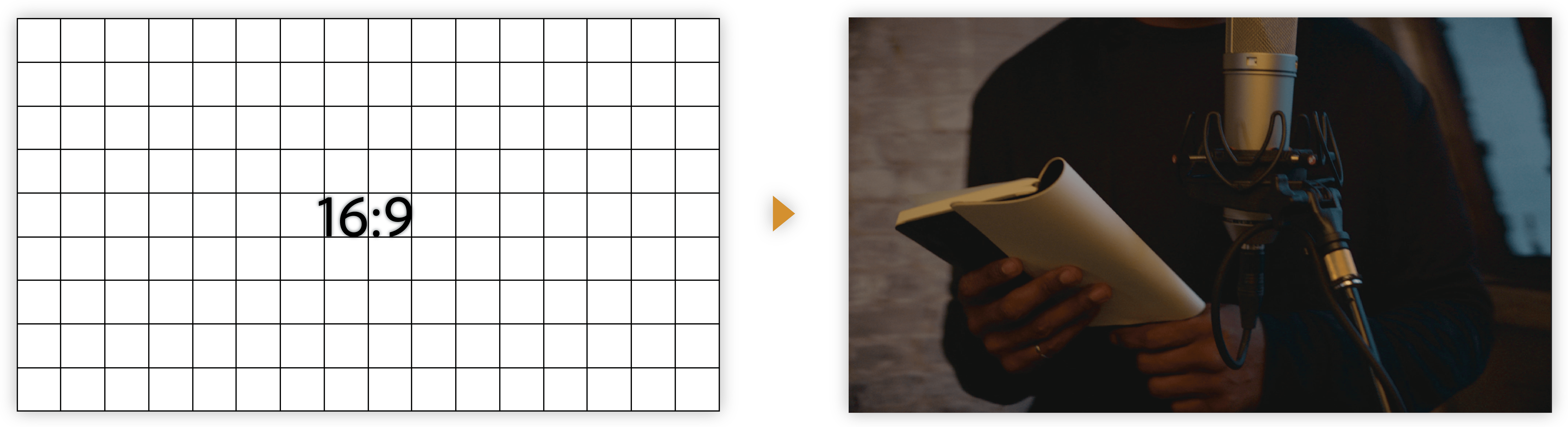
Widescreen (16:9)
It is the standard aspect ratio unremarkably shared by online videos, documentaries, and films. It captures a large amount of data with details.
Vertical (ix:16)
Information technology is the video recorded on your phone.

Fullscreen (4:three)
It is the aspect ratio that was used on television set earlier widescreen was used. Information technology focused on a particular element at a fourth dimension.

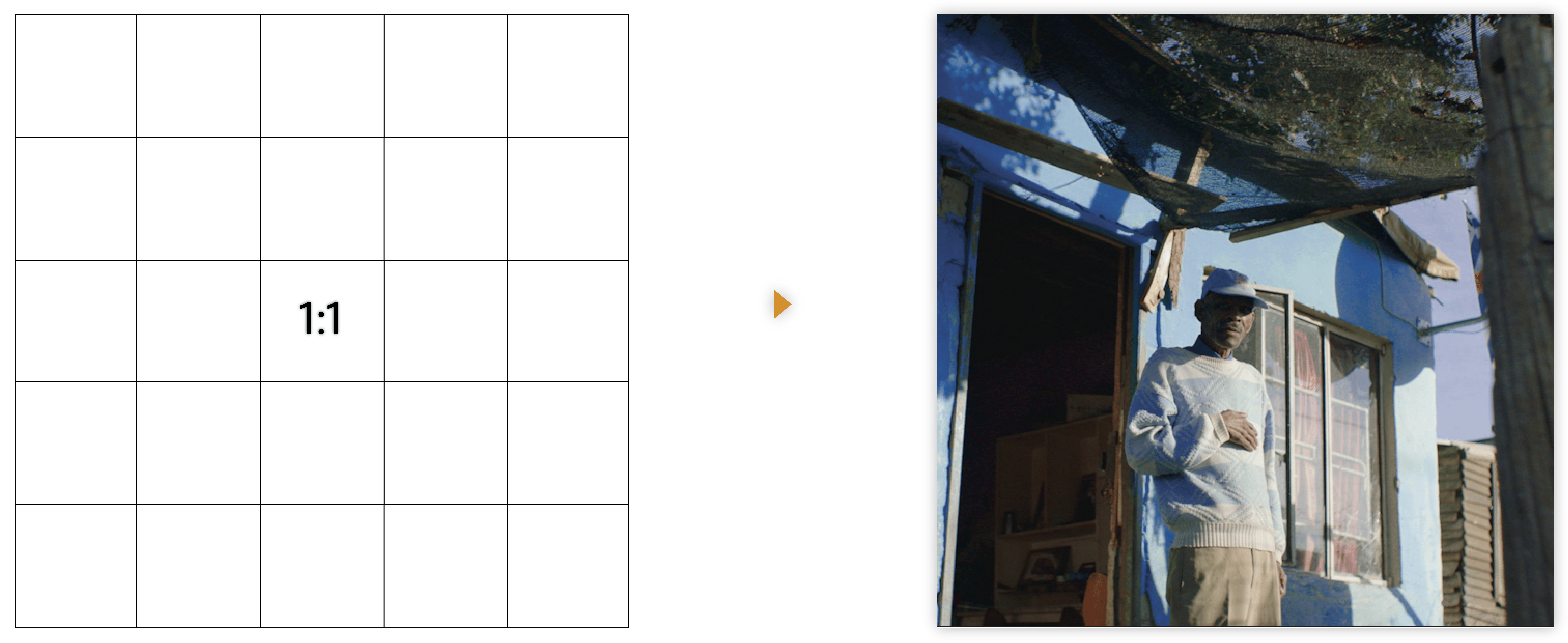
Square (i:one)
It is a perfect square ratio that is ordinarily used on Instagram.
Anamorphic (two.40:ane)
It is a wide widescreen often used in movies. Information technology is like to 16:9 but the height and bottom are cropped. This effect gives information technology a cinematic feel.

Fix the aspect ratio
To prepare the aspect ratio of a sequence:
-
Get to the Settings tab of the New Sequence dialog box.
-
Nether Video, enter the Frame Size(height) and horizontal(width). Premiere Pro automatically generates the aspect ratio.
-
Fill out the respective fields, name the sequence, and click OK.
The aspect ratio for the sequence has been prepare.
Frame aspect ratio
Frame aspect ratio describes the ratio of width to height in the dimensions of an paradigm. Video and still picture frames have a frame attribute ratio.
For example, DV NTSC has a frame aspect ratio of 4:3 (or 4.0 width past three.0 pinnacle). A typical widescreen frame has a frame attribute ratio of 16:9. Many cameras that have a widescreen mode tin record using the 16:9 aspect ratio. Many films have been shot using even wider attribute ratios.

In Premiere Pro, y'all can implement the letterboxing or the pan and scan technique by using Motion effect properties such as Position and Scale.
Letterboxing
When you import clips shot in one frame aspect ratio into a project that uses some other frame aspect ratio, y'all decide how to reconcile the different values. This placement leaves blackness bands above and below the moving-picture show frame, chosen letterboxing.
For example, two common techniques are used for showing a sixteen:ix motion picture on a 4:3 standard idiot box. You tin can fit the entire width of the 16:ix moving-picture show frame within the 4:3 idiot box frame.
Pan and scan
Pan and scan is an alternative method to use a project with another frame aspect ratio. Merely a part of the frame is retained, while the rest is lost.
For example, another technique to show a 16:9 film on a 4:iii standard television is to fill the 4:3 frame vertically with the unabridged height of the 16:9 frame. And so, yous pan the horizontal position of the sixteen:9 frame inside the narrower 4:3 frame so that important activeness e'er remains inside the 4:3 frame.

Pixel aspect ratio
Pixel aspect ratio describes the ratio of width to elevation of a single pixel in a frame. The pixels that brand upward a frame take a pixel aspect ratio (sometimes referred to every bit PAR). Pixel attribute ratios vary considering different video systems make various assumptions almost the number of pixels that are required to fill a frame.
For example, many computer video standards ascertain a iv:iii attribute ratio frame every bit 640x480 pixels loftier, which results in square pixels. The computer video pixels take a pixel aspect ratio of one:ane (square). Video standards such as DV NTSC ascertain a 4:3 aspect ratio frame as 720x480 pixels, which result in narrower, rectangular pixels. The DV NTSC pixels have a pixel attribute ratio of 0.91 (nonsquare). DV pixels, which are always rectangular, are vertically oriented in systems producing NTSC video and horizontally oriented in systems producing PAL video. Premiere Pro displays clip pixel aspect ratio next to the clip epitome thumbnail in the Project panel.

A. 4:3 square-pixel prototype displayed on four:3 square-pixel (estimator) monitorB. 4:3 foursquare-pixel image interpreted correctly for display on 4:iii non-square pixel (TV) monitorC. 4:3 square-pixel image interpreted incorrectly for display on iv:3 non-square pixel (TV) monitor
The clean aperture is the portion of the image that is free from artifacts and distortions that appear at the edges of an image. The production aperture is the unabridged paradigm.
Distorted images
If you display rectangular pixels on a foursquare-pixel monitor without alteration, images appear distorted. For example, circles misconstrue into ovals. Yet, when displayed on a broadcast monitor, the images announced correctly proportioned because broadcast monitors utilize rectangular pixels. Premiere Pro tin display and output clips of various pixel aspect ratios without baloney. Premiere Pro attempts to automatically reconcile them with the pixel aspect ratio of your project.
You could occasionally meet a distorted clip if Premiere Pro interprets pixel attribute ratio incorrectly. You can right the distortion of an individual prune by manually specifying the source prune pixel attribute ratio in the Translate Footage dialog box.

Apply assets with various aspect ratios
When an asset is imported, Premiere Pro attempts to preserve the frame attribute ratio, pixel aspect ratio, and frame dimensions so the asset does non appear cropped or distorted.
For avails that comprise metadata, these calculations are automatic and precise. For example:
- When you capture or import NTSC footage with the ATSC frame size of 704x480, the D1 frame size of 720x486, or the DV frame size of 720x480, the pixel attribute ratio is ready to D1/DV NTSC (0.91).
- When y'all capture or import footage with the HD frame size of 1440x1080, the pixel aspect ratio is set to Hard disk drive 1080 Anamorphic (1.33).
- When you capture or import PAL footage with the D1 or DV resolution of 720x576, the pixel aspect ratio is set to D1/DV PAL (1.094).
For other frame sizes, Premiere Pro assumes that the asset was designed with square pixels and changes the pixel aspect ratio and frame dimensions to preserve the image aspect ratio. If the imported asset is distorted, you tin modify the pixel attribute ratio manually.
Avails in a sequence
When you drag an nugget into a sequence, the asset is placed at the eye of the program frame by default. Depending on its frame size, the resulting image could be also small or over cropped for the needs of the projection. Premiere Pro can alter its scale automatically when you drag an nugget into a sequence, or you can change it manually.
It is always important to interpreted files correctly. You tin can read nugget frame dimensions and pixel aspect ratio near the preview thumbnail and in the Video Info cavalcade of the Project console. You lot can likewise find this data in the asset Properties dialog box, the Interpret Footage dialog box, and the Info panel.
Aspect ratio distortion in sequences
The sequence settings preset you choose when y'all create a sequence sets the frame and pixel aspect ratios for the sequence. You can't alter aspect ratios after you create the sequence, but you can change the pixel attribute ratio that Premiere Pro assumes for private avails.
For example, if a square-pixel asset generated by a graphic looks distorted in Premiere Pro, you can right its pixel aspect ratio to make information technology wait right. Past ensuring that all files are interpreted correctly, you tin can combine footage with different ratios in the same project. And so y'all can generate output that doesn't misconstrue the resulting images.
Right aspect ratio misinterpretations
Right individual attribute ratio misinterpretations
To correct private aspect ratio interpretation, do the following:
-
Right-click the notwithstanding prototype in the Projection panel.
-
Select Prune >Modify > Translate Footage .
If you select a prune on the Timeline panel or Program monitor, the choice is unavailable.
-
Select 1 of the following in the Pixel Aspect Ratio department:
Use Pixel Aspect Ratio From File
Uses the original aspect ratio saved with the notwithstanding image.
Conform To
Lets you choose from a list of standard aspect ratios.

Modify prune When using Photoshop to generate images for utilise in video projects, it's best to use the Photoshop preset named for the video format you'll utilise. Using the preset ensures that your images are generated with the correct aspect ratio.

Common pixel aspect ratios
| Pixel aspect ratio | When to use | |
| Foursquare pixels | 1.0 | Footage has a 640x480 or 648x486 frame size, is 1920x1080 HD (not HDV or DVCPRO HD), is 1280x720 Hard disk drive or HDV, or was exported from an application that doesn't support nonsquare pixels. This setting tin can also be appropriate for footage that was transferred from film or for customized projects. |
| D1/DV NTSC | 0.91 | Footage has a 720x486 or 720x480 frame size, and the desired event is a four:3 frame aspect ratio. This setting tin also be advisable for footage that was exported from an application that works with nonsquare pixels, such as a 3D animation application. |
| D1/DV NTSC Widescreen | 1.21 | Footage has a 720x486 or 720x480 frame size, and the desired result is a 16:ix frame attribute ratio. |
| D1/DV PAL | 1.09 | Footage has a 720x576 frame size, and the desired effect is a 4:3 frame attribute ratio. |
| D1/DV PAL Widescreen | 1.46 | Footage has a 720x576 frame size, and the desired result is a sixteen:9 frame aspect ratio. |
| Anamorphic 2:one | 2.0 | Footage was shot using an anamorphic film lens, or it was anamorphically transferred from a film frame with a 2:ane aspect ratio. |
| HDV 1080/DVCPRO HD 720, Hard disk drive Anamorphic 1080 | 1.33 | Footage has a 1440x1080 or 960x720 frame size, and the desired effect is a 16:ix frame aspect ratio. |
| DVCPRO HD 1080 | 1.5 | Footage has a 1280x1080 frame size, and the desired effect is a 16:9 frame aspect ratio. |

How To Change Sequence Size In Premiere,
Source: https://helpx.adobe.com/premiere-pro/using/aspect-ratios.html
Posted by: mccullochmatived76.blogspot.com
0 Response to "How To Change Sequence Size In Premiere"
Post a Comment