

How A 30 Year Old Black Man Can Make His Money Work For Him
The racial news in America has been sobering in recent years. From Trayvon Martin to Walter Scott, from Ferguson to Charlottesville, one incident after another has cast a mantle over race relations in the nation. In fact, the share of Americans who consider racism a large trouble has nearly doubled in the terminal decade. Meanwhile, recent research on race—including Raj Chetty and colleagues' new written report showing that black boys' take chances of moving upwardly the economic ladder are much lower than white boys—merely makes the picture wait worse.
But the negative news most race in full general and black men, in particular, is non the whole story. Our new written report, Black Men Making It In America, finds that despite the burdens they face—from residential segregation to workplace bigotry to over incarceration—more than than one-half of black men have made it into the middle or upper class equally adults. This means that millions of blackness men are flourishing financially in America.
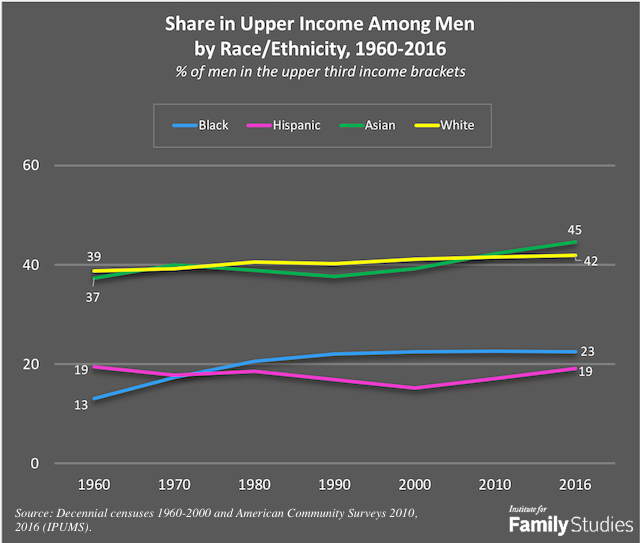
But how many black men take fabricated it, specifically, into the American upper class? In a new assay of Demography data, we observe that slightly more one-in-v (or about 2.v million) black men ages 18 to 64 take made it into the upper-third of the income distribution.
Notes: Based on adults ages 18 to 64. Income refers to total family unit income adjusted past family unit size.
In fact, black men have fabricated marked progress over the last half-century in reaching the upper ranks of the income ladder. The share of blackness men who are in the upper-income bracket rose from thirteen% in 1960 to 23% in 2016, co-ordinate to our analysis. Moreover, poverty amid black men has dropped dramatically over the same time, with the share of black men in poverty falling from 41% to 18% since 1960.
What is Fueling Their Success?
Using information from the National Longitudinal Survey of Youth (1979) that tracks blackness men from their teenage years to midlife, we discover that a majority of upper-income black men in their fifties today are from humble roots. For example, 59% were lower-income when they were teenagers or young adults. And about half of them grew up outside of an intact, two-parent family. However, these men made it into the upper course despite the challenges they faced through thirty-plus years of life. What paths did they accept to the meridian?
We identified three major factors that are linked to the financial success of black men in midlife today: education, piece of work, and matrimony. Blackness men who take a higher degree, a full-time task, or a spouse are much more likely than their peers to cease upward in the upper-income bracket as fifty-something men.
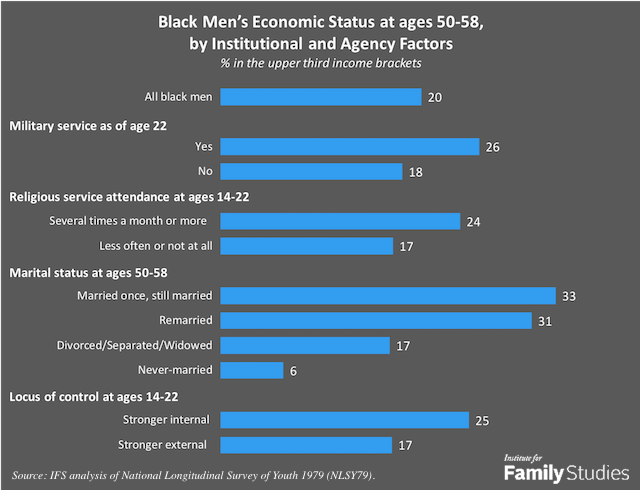
Nearly half of black men with a available's or higher caste have fabricated it to the top income by age 50, compared with merely xiv% of high school graduates and 22% of black men with some college teaching. And more than iii-in-x married blackness men (regardless of whether they are in their outset marriage or not) are in the upper-income group, compared with only half-dozen% of never-married black men. In a multivariate analysis that includes a range of factors, educational activity, work, and marriage are highly predictive of black men's economic success.
Moreover, a number of early on life experiences are associated with black men's elevated odds of beingness financially successful. Black men who served in the war machine or attended church regularly as young adults are more likely to have made it to the upper form by historic period 50. The impact of armed forces experience on blackness men'southward success seems to piece of work through its links with blackness men's work and marital status. That is, black men who served in the military early in life are more probable to be working full time and to be married later in life.
Having a sense of personal agency also is linked to black men'south success. Black men who believed at a young age that they were mostly responsible for their lives rather than outside forces (measured by a locus of control scale) are more than likely to flourish later in life.
Notes: Based on adults born betwixt 1957 and 1964. Income refers to total family unit income adjusted by family size.
Our story is not entirely positive. Clearly, the racial gap in success is large, with African American men existence about 20 percentage points less likely to reach the upper class today compared to white and Asian men. One reason that's the case is that black men were more likely to take contact with the criminal justice system. In our analyses, early contact with the criminal justice arrangement hurt black men'south hazard of existence financially successful many years later. After belongings pedagogy, work, and spousal relationship constant, blackness men's contact with the criminal justice system reduced their chance of making it to the upper course by about 70%.
However, focusing only on the negative side of the story for black men has its limitations. First, it renders millions of successful black men, and the paths they take taken to the American Dream, invisible. Second, it tin atomic number 82 to a sense of hopelessness for young black men. As Ian Rowe, the CEO of a charter school network in New York City has noted, with so much talk of "black failure" today, black boys may start to feel "why fifty-fifty bother when the odds are stacked confronting you?"
In order to engender hope for the next generation of young black Americans, we need to spotlight the many positive stories of successful blackness men that are out at that place and identify the routes that these men have taken to rise up the economic ladder. This is specially the case since the majority of black men who made it to the upper class in their mid-fifties came from lower-income households when they were 14 to 22 years old.
To those ends, our new research indicates that i-in-v black men have made it into the upper class, and it suggests that instruction, work, spousal relationship, and military service provide paths that aid blackness men accomplish the American Dream.
Wendy Wang is director of enquiry at the Constitute for Family Studies and a former senior researcher at Pew Research Middle. Westward. Bradford Wilcox is a senior fellow at the Institute for Family Studies, a visiting scholar at the American Enterprise Constitute, and the director of the National Marriage Project at the University of Virginia. Ronald B. Mincy is Maurice V. Russell Professor of Social Policy and Social Work Practice at Columbia University and a co-principal investigator of the Fragile Families and Kid Wellbeing Study.
Source: https://ifstudies.org/blog/2-5-million-black-men-are-in-the-upper-class
Posted by: mccullochmatived76.blogspot.com
0 Response to "How A 30 Year Old Black Man Can Make His Money Work For Him"
Post a Comment